谷歌翻译
Jerusalem's usually bustling Old City becomes a ghost town: Reporter's Notebook_我的网站

A | JERUSALEM -- It's a far cry from the usual hustle and bustle, so typical of Jerusalem's Old City.The steps of the Damascus Gate have been cleared out. Gone are the fruit and sumac vendors. And inside the Old City: rows and rows of shops have shut down."This is the worst days we've ever seen in our lives. Even when the corona[virus] was here it was better than this," said Adnan Jaffa, who runs the Jaffar Sweets shop. "Because of the war ... the situation. In five minutes we're going to close because there is nothing to do."For those who know the Old City, it's an eerie place to be. Even the Church of the Holy Sepulchre -- where Christ is believed to have been buried and resurrected -- was empty on Sunday but for a handful of worshippers. It felt like we were being given a private tour of one of the world's holiest and most visited sites.Ehab Barakat, who was cycling through the deserted Old City, was one of the few customers out there on the city's streets.Asked about the increasing tensions, he said: "We hope it will be quiet."He added, "This is the time to be united. One."But the latest cycle of violence has come has no surprise, he said."The new government of Israel … you would be stupid if you would not guess what is going to happen. And we are not stupid. We were just waiting for the time.""The people get so tied … like a balloon. With a lot of air inside. And then it will…"His English may have failed him -- but it seemed clear what he meant.Israeli police now stand at the entrance to the Damascus Gate, occasionally searching young men. Orthodox Jews occasionally wander through the Old City to worship at the Western Wall. But there is none of the fervour which people associate with Jerusalem. It's been replaced by a strange quiet.In the words of Abushadi Sinjlawi, another shopkeeper we found closing early for the day, "The city is under lockdown."But away from the eerie quiet and melancholy atmosphere in the Old City, the situation is tense. Jerusalem is said to be the most heavily policed city in the country, and that will likely remain the case as the war in the south rages on.Checkpoints have been set up across East Jerusalem. And videos are spreading online appearing to show the harassment of Palestinians at the hands of the police. Cars are being stopped and searched. There are videos of apparent police beatings. In sporadic, individual incidents where locals have clashed with police, the response appears to have been brute force.Already at least 50 Palestinians have been killed in East Jerusalem and the West Bank since the war broke out -- that's more than the highest ever monthly total since the UN began keeping records in 2005.。
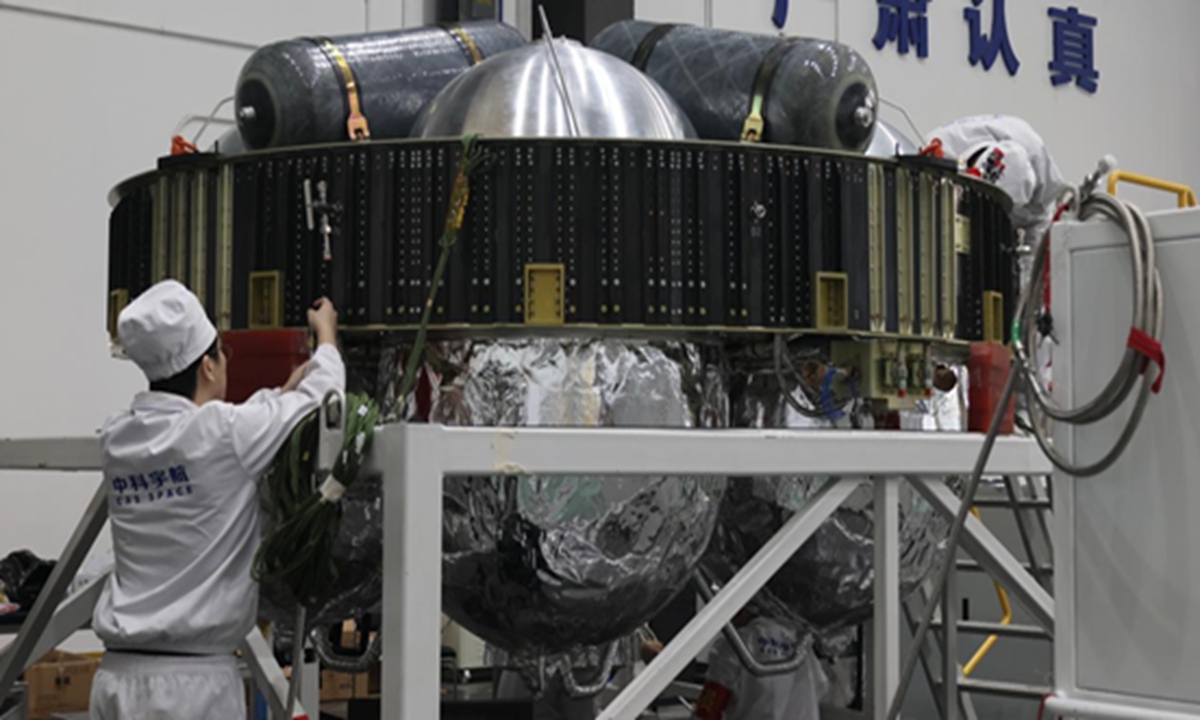
The general assembly of the Lixun-1 upper stage Photo: Courtesy of CAS Space
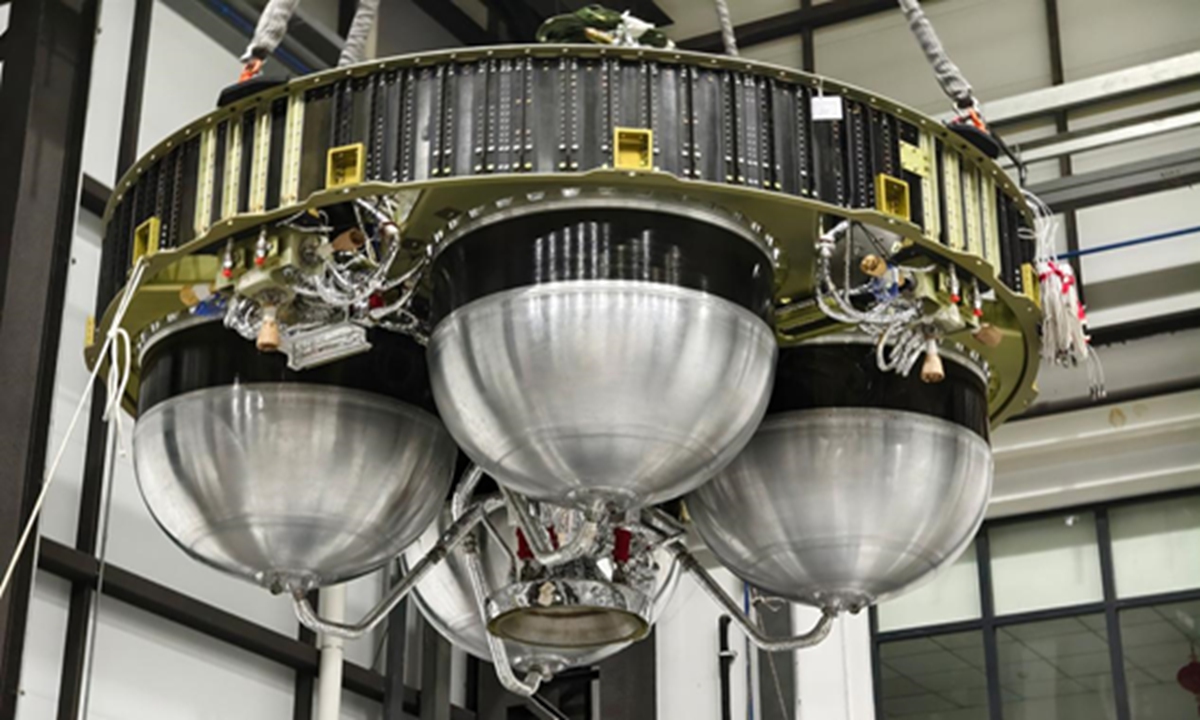
The Lixun-1 upper stage Photo: Courtesy of CAS Space
Lixun-1 upper stage, a versatile "space tug" developed by China's commercial space firm CAS Space, is scheduled to make its maiden flight in the first quarter of 2027 after completing a series of key propulsion-system tests, the developer and its chief designer told the Global Times on Tuesday.
The "tug" is designed to ferry satellites from one orbit to another and support missions ranging from constellation deployment to lunar exploration.
While the main stages of a rocket carry payloads from the ground into an initial orbit, an upper stage takes over once the craft is in space. By repeatedly restarting its engine and changing orbit, Lixun-1 can deliver satellites to higher or different orbits, distribute multiple spacecraft to separate destinations during a single launch, or send probes onto trajectories toward the moon and beyond, Global Times learned from the developer.
Yang Haoliang, chief designer of the Lixun-1 upper stage, compared the system to a shuttle service. "If the regular stages of a launch vehicle are like a long-distance bus," - they carry the upper stage and satellites from Earth to a near-Earth parking orbit - the upper stage then takes over as a "space tug," carrying its satellite "passengers" onward to their designated orbital "stops," Yang explained.
That capability can have a direct impact on how efficiently satellites are launched and operated, Yang said. If a satellite has to climb from an initial orbit to its final destination using its own engine, the process can consume a considerable amount of onboard propellant and reduce the fuel available during its operational life. An upper stage can instead perform that orbital transfer, helping conserve satellite fuel and potentially extend its service life.
It can also make one rocket launch do more work. Instead of releasing a batch of satellites into roughly the same orbit, Lixun-1 can repeatedly ignite its engine and maneuver between deployments, sending different satellites to different altitudes and inclinations. Yang said this would help accelerate constellation deployment while improving the efficiency of individual launches.
The practical ambitions behind the system are backed by a major technical milestone reached this month. In August, Lixun-1 completed its PV-001 integrated propulsion-system coordination firing test, during which the entire system operated smoothly for 566 seconds.
Yang told the Global Times that the current Lixun-1 upper stage has a thrust of 20 kilonewtons and can achieve a specific impulse of 315 seconds, which he described as reaching an internationally leading level. The August firing covered the planned profile for the maiden mission, an important step before the system proceeds to flight testing.
The test was more than a demonstration of the engine itself. As an important system-level verification during development, it examined the coordination and engineering reliability of the engine pressurization system, propellant delivery system, propellant management system and servo-control system under the fully integrated configuration.
Of a series of tests that accumulated 5,211 seconds of firing time, the latest one focused on three core technologies: a high-thrust, high-performance 20-kilonewton upper-stage engine capable of multiple starts; balanced propellant delivery from multiple parallel tanks; and a highly reliable integrated electrical system. Their successful verification means Lixun-1 has completed its system-level testing and is ready to move into the flight-test phase, according to the developer.
Lixun-1 has been designed as a modular and generally adaptable upper stage rather than a system tied to only one rocket. It is intended to work with CAS Space's Kinetica-2 and Kinetica-2 heavy-lift variants as well as other launch vehicles, Yang said.
When paired with the Kinetica-2 family, Lixun-1 could significantly expand the rocket's mission range. For communications missions, it could deliver satellites to geosynchronous transfer orbit or even directly to geosynchronous orbit, conserving satellite propellant while supporting the deployment of high-throughput satellites and future 6G communications spacecraft.
For multi-satellite missions, the combination could distribute spacecraft to different orbital altitudes and inclinations during a single launch, potentially serving both low-Earth-orbit constellations and medium- or high-orbit payloads. For deep-space missions, it could place probes onto Earth-moon transfer trajectories and support lunar exploration, Yang said.
The upper stage is designed to be able to conduct more than 20 engine ignitions, autonomously plan orbital-transfer routes and operate under the vacuum and extreme temperature conditions of space. After completing payload deployment, it can also carry out orbital disposal maneuvers to reduce space-debris risks.
Yang said the Lixun-1 and Kinetica-2 combination is designed to cover the vast majority of commercial satellite launch requirements while retaining the ability to participate in major national space projects. More broadly, the upper stage forms part of CAS Space's effort to build launch capabilities reaching medium and high Earth orbits and deep space, extending the reach of China's commercial space sector toward higher orbits and more distant destinations.
。
Current article:http://w2f3u.tichannangenzhuchuapin.cfd/list_n429r/9wccq.html
Published on:11:01:19





 发表于 16:49:11
 QQ好友和群
 QQ空间
QQ空间 腾讯微博
腾讯微博 腾讯朋友
腾讯朋友 收藏
收藏 支持
支持 反对
反对
 发表于 13:53:28


